Hughes2009: Tutorial and Data Processing
Hughes2009-tutorial.RmdInstallation
# Install via pak
if (!requireNamespace("pak", quietly = TRUE)) install.packages("pak")
pak::pak("altintasali/Hughes2009")
Raw Expression Data
First, we load the raw eset object and perform initial
quality checks to ensure data integrity.
show(eset)
#> ExpressionSet (storageMode: lockedEnvironment)
#> assayData: 45101 features, 48 samples
#>   element names: exprs
#> protocolData
#>   sampleNames: GSM301348.CEL.gz GSM301349.CEL.gz ... GSM301395.CEL.gz
#>     (48 total)
#>   varLabels: ScanDate
#>   varMetadata: labelDescription
#> phenoData
#>   sampleNames: GSM301348 GSM301349 ... GSM301395 (48 total)
#>   varLabels: title geo_accession ... relation.1 (33 total)
#>   varMetadata: labelDescription
#> featureData
#>   featureNames: 1415670_at 1415671_at ... AFFX-r2-P1-cre-5_at (45101
#>     total)
#>   fvarLabels: PROBEID SYMBOL GENENAME MAS5_CALL
#>   fvarMetadata: labelDescription
#> experimentData: use 'experimentData(object)'
#> Annotation: mouse4302
Here is how the expression matrix look like:
expression_matrix_raw <- exprs(eset)
print(expression_matrix_raw[1:6, 1:6])
#>              GSM301348.CEL.gz GSM301349.CEL.gz GSM301350.CEL.gz
#> 1415670_at          10.047478        10.144396        10.032522
#> 1415671_at          10.742481        10.572902        10.678695
#> 1415672_at          11.134648        11.113839        11.060911
#> 1415673_at           8.123238         8.375692         8.467279
#> 1415674_a_at         8.814808         8.788226         8.699853
#> 1415675_at           7.563833         7.303640         7.322527
#>              GSM301351.CEL.gz GSM301352.CEL.gz GSM301353.CEL.gz
#> 1415670_at           9.804604         9.990287         9.682311
#> 1415671_at          10.648379        10.714002        10.591531
#> 1415672_at          11.280906        11.074163        11.186339
#> 1415673_at           8.129796         8.236522         8.042468
#> 1415674_a_at         8.768019         8.587714         8.366756
#> 1415675_at           7.430643         7.668505         7.474612
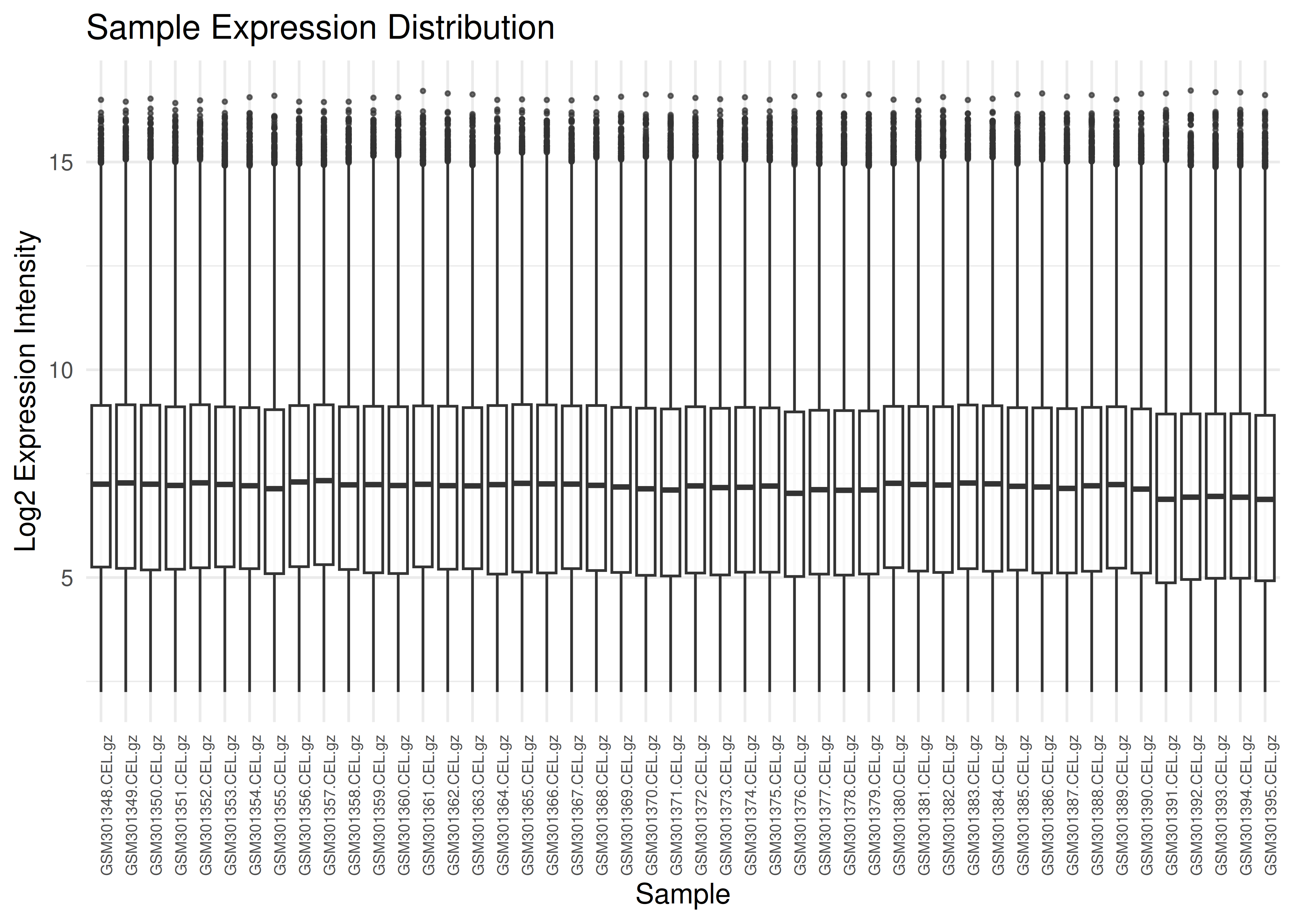
Boxplots
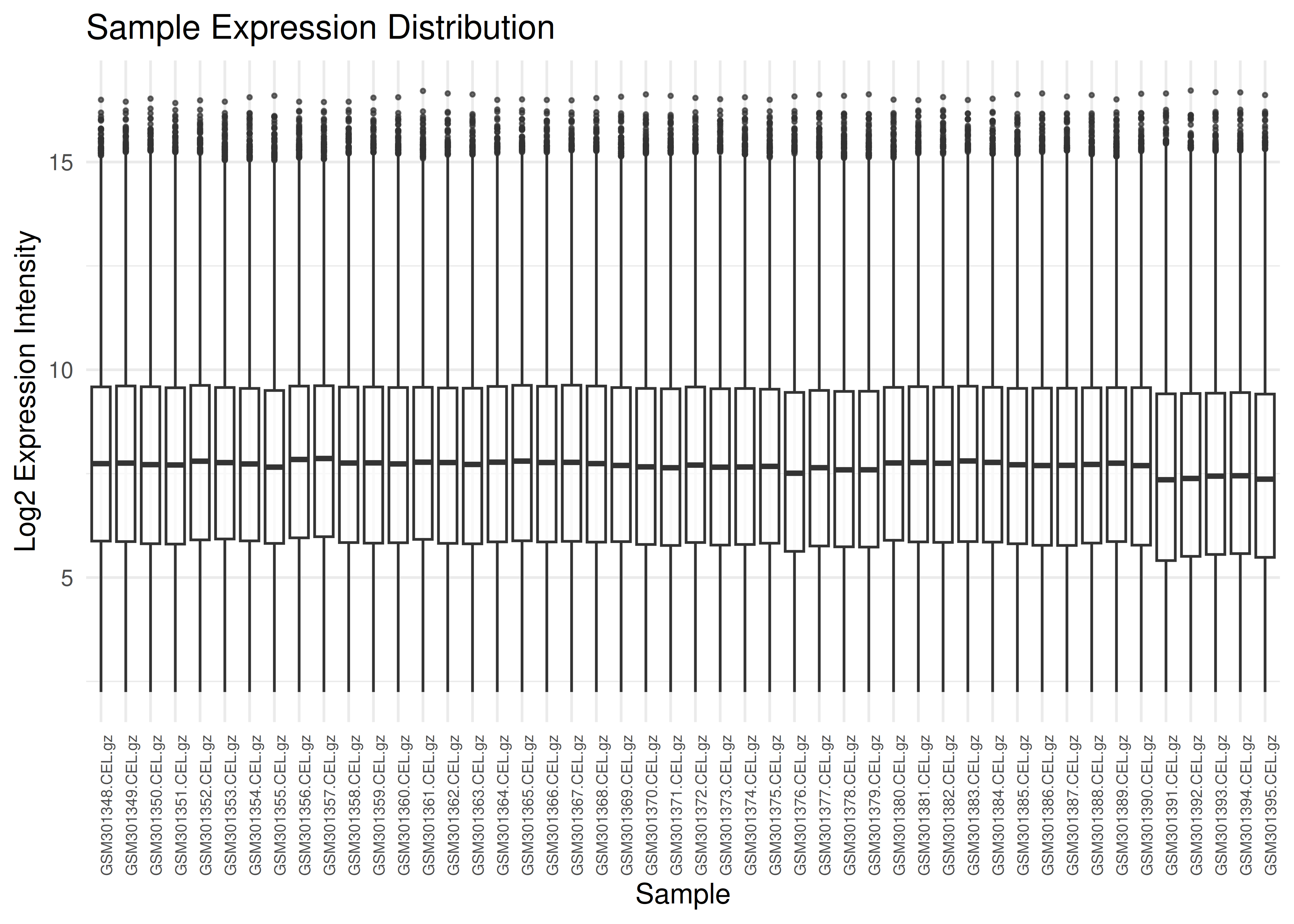
Visualizing expression distributions helps identify outliers or normalization issues.
plot_boxplots(eset)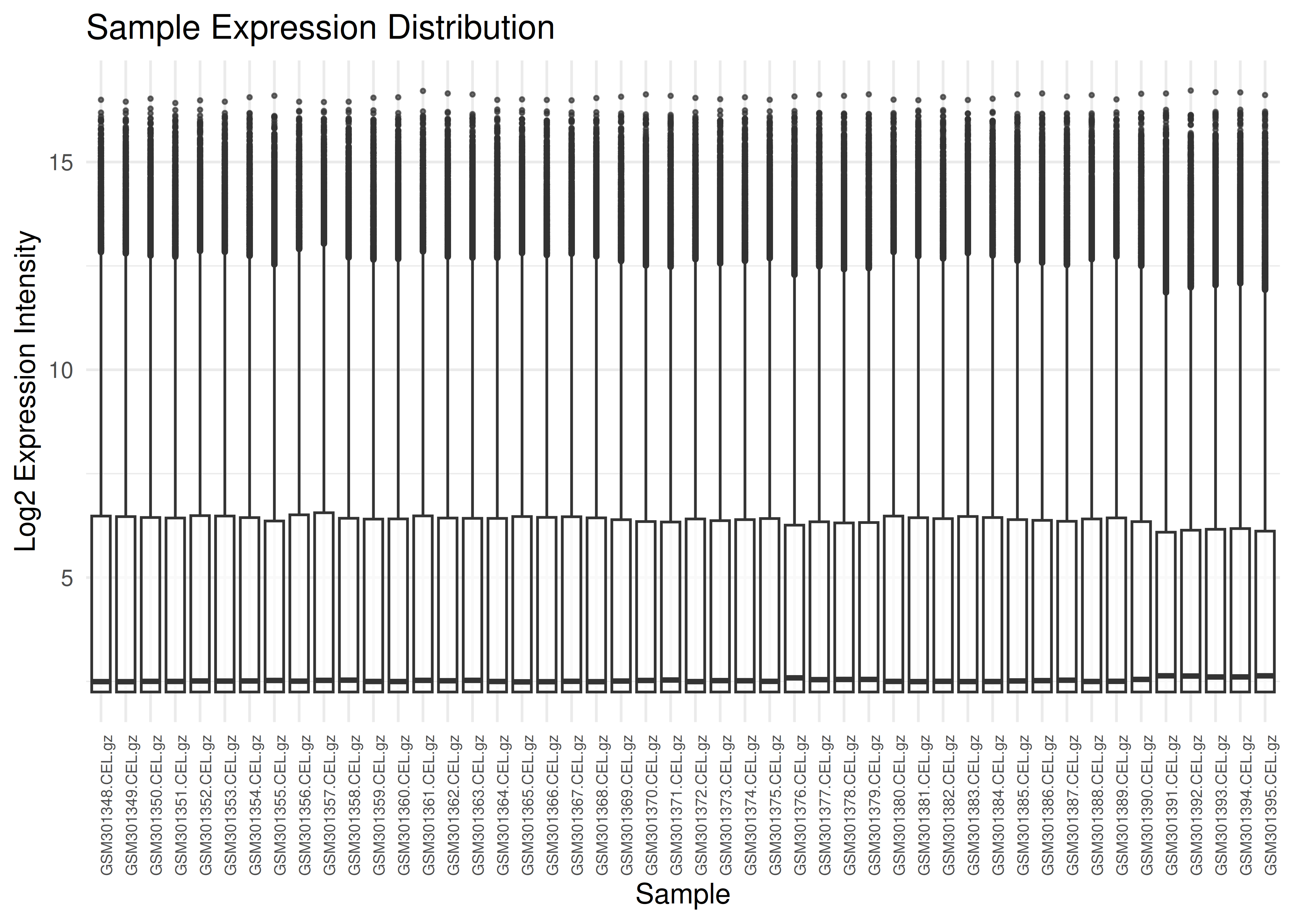
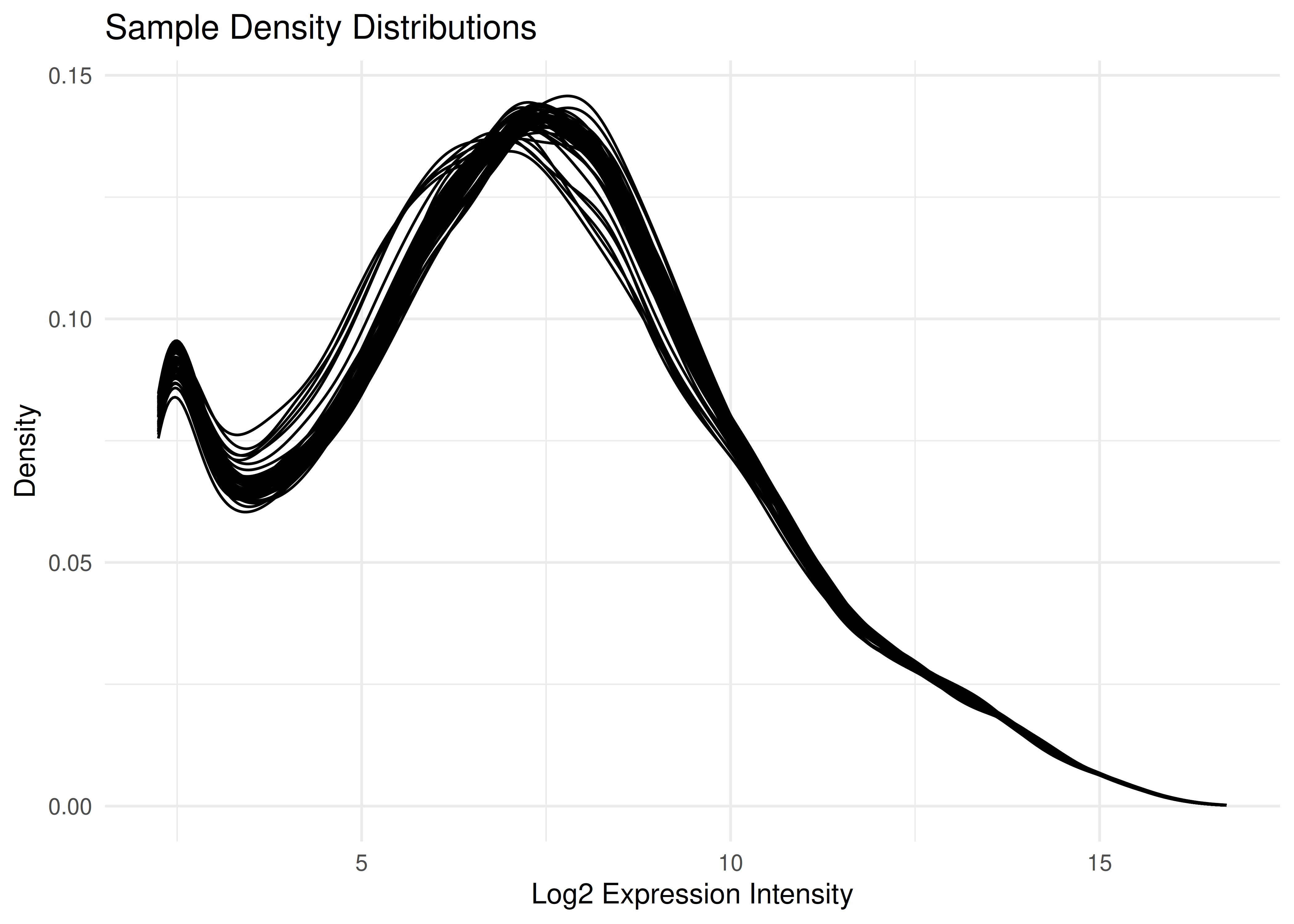
Density Plots
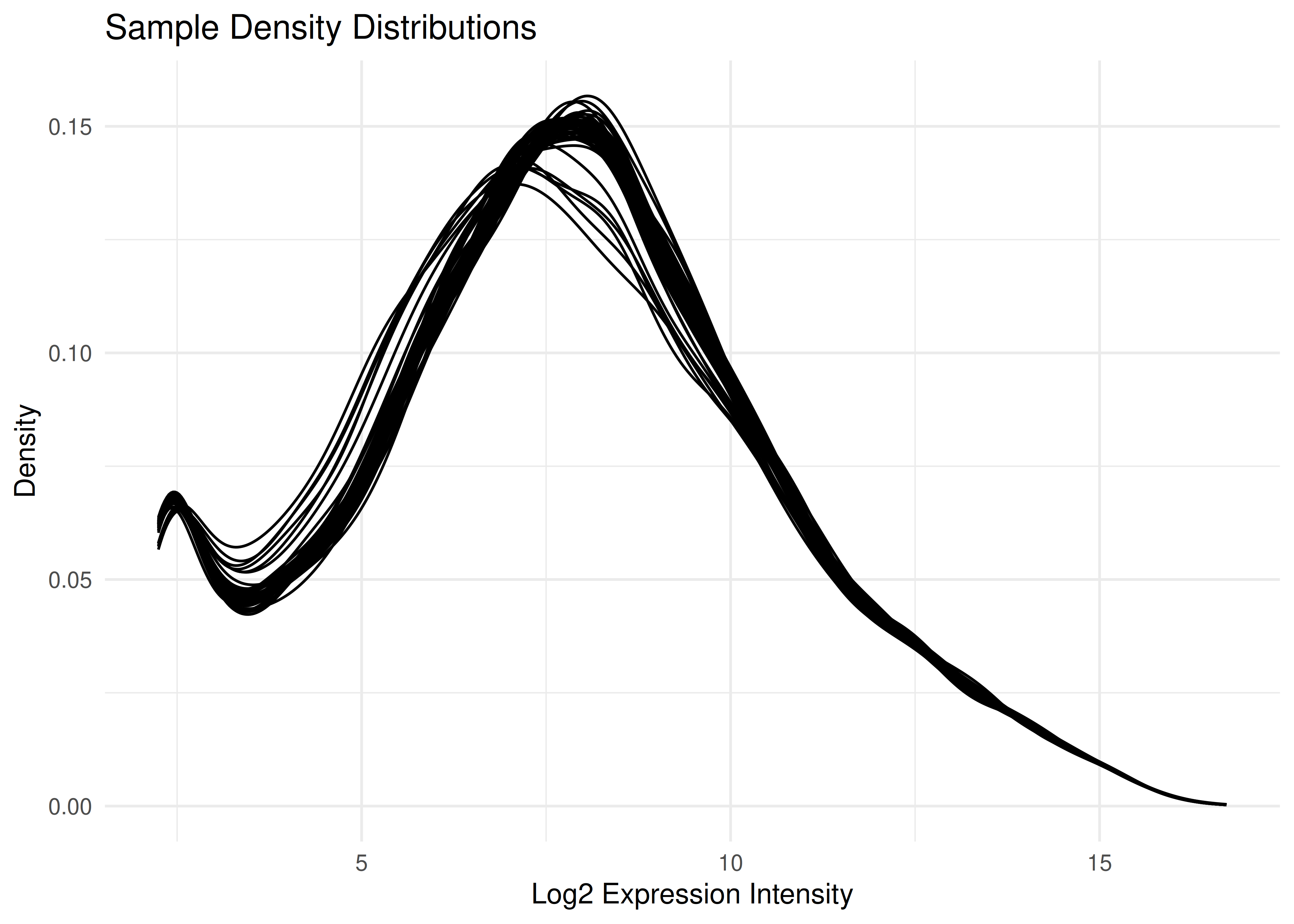
Visualizing all 96 samples overlaid helps ensure there are no massive outliers or batch effects in the normalization.
plot_densities(eset)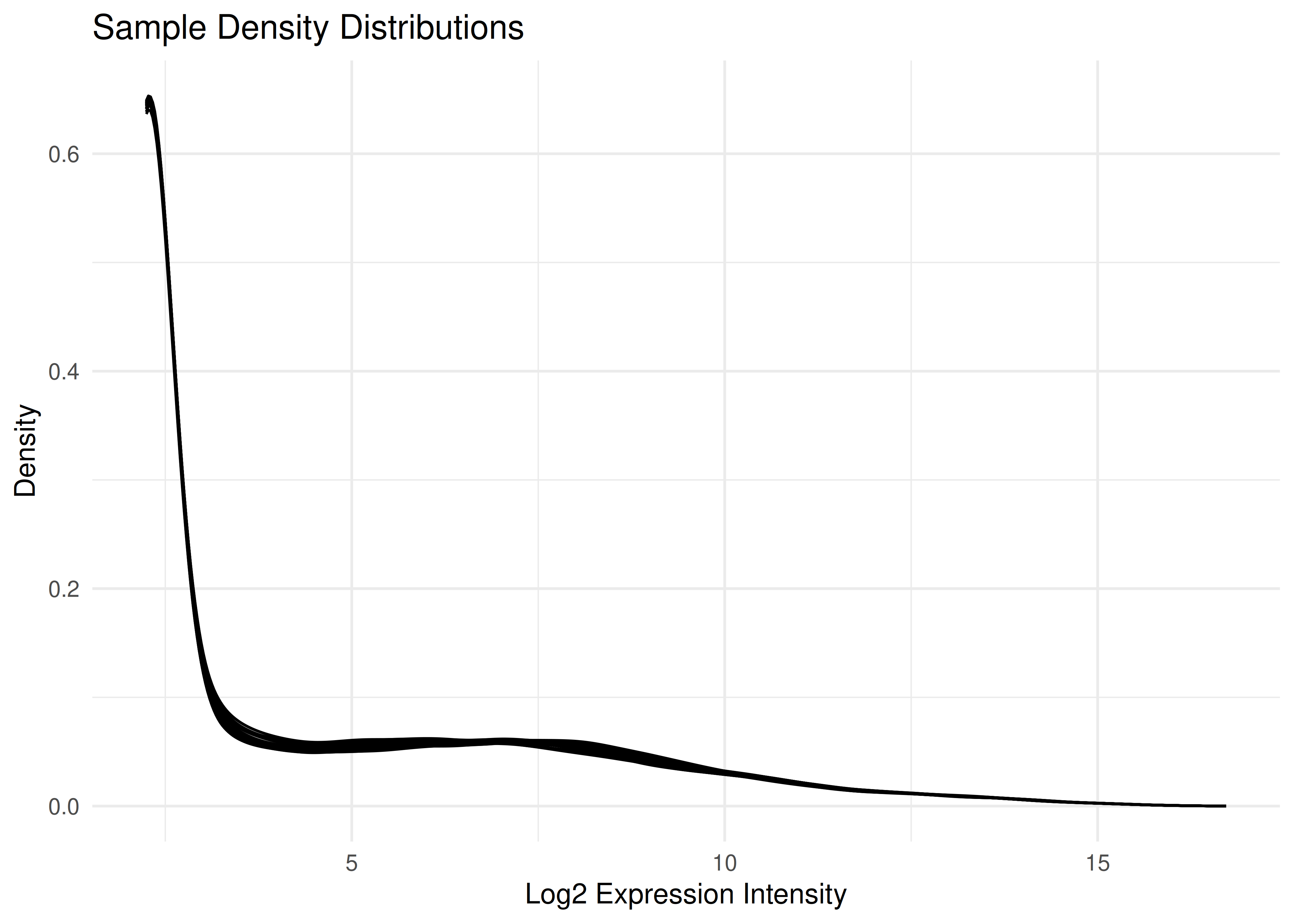
MD Plots
In the limma
R package, an MD plot (Mean-Difference plot) is a specific type of MA
plot used to visualize gene expression data. Its primary role in Quality
Control (QC) is to identify systematic biases and assess the
effectiveness of normalization.
Below is the MD plot for the first sample:

Filtering
Probes with low expression or inconsistent signal (MAS5
“Absent” calls) can introduce noise. We filter the dataset to retain
only high-quality, reliable probes. You can play around with
min_present parameter below to find the optimum filtering
option.
# Filter for probes present in at least 20 samples
eset_filt <- filter_mas5(eset, min_present = 20)

cat(sprintf("Original number of probes: %d\n", nrow(eset)))
#> Original number of probes: 45101
cat(sprintf("Probes remaining after filtering: %d\n", nrow(eset_filt)))
#> Probes remaining after filtering: 18207
It is also a good practice to run QC diagnostics after filtering.

Collapsing by Gene Name
Since multiple probes may target the same gene, we collapse the
probe-level data to the gene level using the WGCNA’s
collapseRows
function (MaxMean method).
eset_gene <- collapse_eset(eset_filt, method = "MaxMean")

expression_matrix_gene <- exprs(eset_gene)
print(expression_matrix_gene[1:6, 1:6])
#>               GSM301348.CEL.gz GSM301349.CEL.gz GSM301350.CEL.gz
#> 0610005C13Rik        10.284146        10.113265        10.205917
#> 0610010K14Rik         7.031768         7.184750         7.147965
#> 0610030E20Rik         7.544658         7.622270         7.650212
#> 0610040B10Rik         4.385660         4.527042         4.495156
#> 0610040J01Rik         8.168452         8.135460         7.934248
#> 0710001D07Rik         5.251084         4.523976         4.477646
#>               GSM301351.CEL.gz GSM301352.CEL.gz GSM301353.CEL.gz
#> 0610005C13Rik        10.158957        10.139734        10.150583
#> 0610010K14Rik         7.215943         7.087089         7.107502
#> 0610030E20Rik         7.823527         7.897321         8.062840
#> 0610040B10Rik         4.873537         4.765729         4.350292
#> 0610040J01Rik         8.032270         7.943563         7.893394
#> 0710001D07Rik         4.410543         4.265482         4.517288